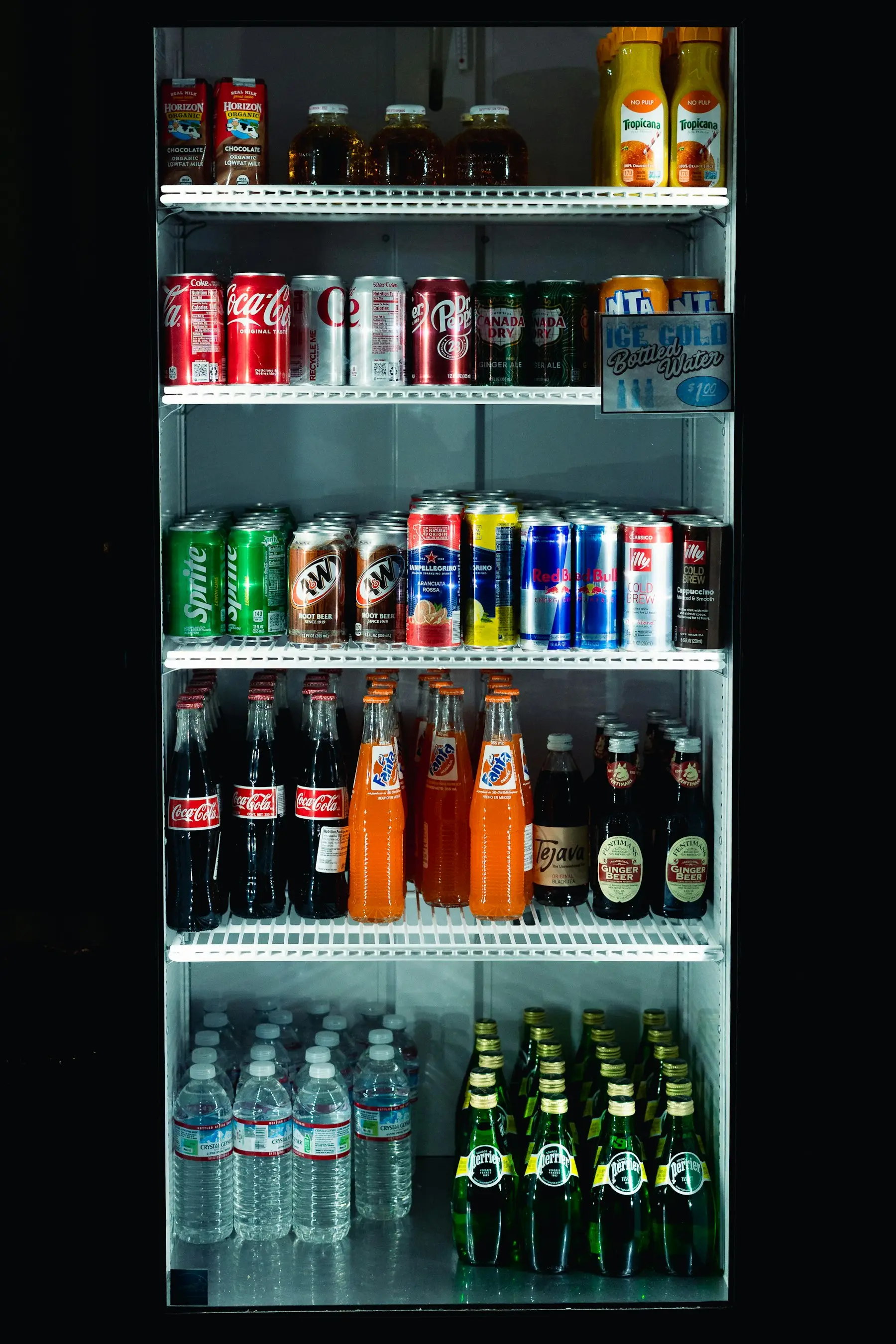
Micromart leases its smart fridge at $230 a month for 36 months plus freight, then sells it to the operator for $300. Over the term that is $8,580 for a fridge that costs $6,295 cash (Micromart).
Vending.com finances purchases but does not lease. Its financing FAQ says: “We do not offer lease or rent-to-own programs” (Vending.com). Loans and dealer finance plans are on vending machine financing.
Who rents or leases machines to operators
Prices as published on October 3, 2026. “From” means the seller’s own “starting at” or “as low as” figure.
| Seller and machine | Structure | Monthly | Term | Upfront | At the end | Cash price |
|---|---|---|---|---|---|---|
| Micromart Smart Fridge | Lease | $230 | 36 months | Freight | $300 buyout | $6,295 |
| 365/Cantaloupe CV Vantage, cooler only | Lease-to-own | From $159.99 | 36 months | $495 | Owned, no buyout | $5,900 |
| CV Vantage with pushers | Lease-to-own | From $169.99 | 36 months | $495 | Owned, no buyout | $6,260 |
| Cantaloupe One Smart Store 600 | Rental | $399 | 36-month commitment | $0 store price | Cantaloupe keeps it | $7,495 |
| Atlantic Smart Vending, Vendera cooler | Lease | From $149 | Not published | Not published | Not published | $3,695 sale, $3,995 regular |
| Vending World, Dixie Narco 501E, refurbished | Clicklease lease | From $47.38 | Not shown | Doc fee | Purchase option | $1,895 |
Micromart lists its platform fee, $60 a month plus 4% and $0.10 a transaction, beside both the cash and lease prices. The CV Vantage carries a $10 monthly Max Aware fee and a subscription fee listed as “5% per month”, minimum $25, maximum $199, on every plan. Cantaloupe deducts the $399 from the operator’s “flow of funds” and starts billing 30 days after purchase or at the first network report, whichever comes first.
Clicklease charges no down payment but a documentation fee of $79 to $499 that “doesn’t go toward the balance”. Every Clicklease lease includes a purchase option; typically the customer makes three more monthly payments after the term and then owns the equipment.
What each costs over the term
Totals use only the published figures. Freight, sales tax, platform fees, and card processing are left out; the sellers list the platform and processing fees on their cash prices too.
- Micromart lease: $230 × 36 = $8,280, plus the $300 buyout = $8,580. That is $2,285 more than the $6,295 cash price.
- CV Vantage lease-to-own, cooler only: $159.99 × 36 = $5,759.64, plus $495 down = $6,254.64. That is $354.64 more than $5,900. With pushers, $169.99 × 36 + $495 = $6,614.64 against $6,260, the same $354.64 gap. Cantaloupe says the final monthly payment is confirmed with the quote.
- Cantaloupe One rental: $399 × 36 = $14,364, and the machine goes back to Cantaloupe. Buying the same Smart Store 600 lists at $7,495. The subscription includes Cantaloupe’s warranty for the term, and Cantaloupe says it will replace devices that reach end-of-life “at no cost to you” (Cantaloupe One). From month 37 the subscription runs month to month. I’d only take this rental if the warranty and replacement promise were worth more to me than owning the machine, since the 36 payments come to more than its purchase price.
- Atlantic and Clicklease: no term is published, so the total cannot be worked out. Clicklease tells customers to multiply the monthly payment by the number of payments. I’d get the number of payments and the documentation fee in writing before setting a Clicklease offer against the cash price. Vending World’s “as low as” figures are each 2.5% of the machine price ($1,895 × 0.025 = $47.375).
Leaving early has a price too. Cantaloupe’s early termination fee is the monthly fee times the months left: ending a Smart Store 600 after 12 months costs $399 × 24 = $9,576. Rented equipment must go back within 60 days of the end, or Cantaloupe bills for the device. I wouldn’t sign a 36-month rental for a location I had not yet tested.
What the lease contract puts on the operator
Micromart publishes its full sub-lease agreement. The lessor is CSC Leasing Co., and Micromart sub-leases to the operator. Among its terms:
- Rent is due in advance on the 1st of each month whether or not an invoice arrives, with a 5% late fee after five days.
- The obligation to pay is “absolute and unconditional” and “shall not be affected by any circumstances whatsoever”, including any claim the operator has against Micromart, the lessor, or the equipment vendor.
- The operator carries the risk of loss and must insure the equipment for the greater of its replacement value or the “Stipulated Loss Value”.
- The operator maintains and repairs the equipment at its own expense, and on return pays transport, rigging, and de-installation.
- The agreement calls itself a “true lease” and says title stays with the lessor. At expiration it provides for return or renewal and does not mention the $300 buyout shown on the pricing page. Before signing, I’d ask for the buyout to be written into the agreement itself.
When a business asks you for a machine
Capital Vending, a Maryland operator, publishes the two arrangements it offers a business and where it draws the line between them. In its free full service, the operator supplies the machine and a route driver refills it, with no involvement from the business; in a rental, the business pays a monthly fee and runs the machine itself. Its pages carry a 2015 copyright footer, so the prices may be out of date.
- Free full service goes to sites that sell enough to cover the equipment and the labor to fill it: “Generally a business that has 75 full time people on staff 5 days a week” (Capital Vending).
- Rental is offered to smaller sites. The business loads its own product, sets prices, and keeps the profit. Monthly rents are $75 for a glass-front snack machine or stack can vendor ($95 for one size), $100 for a narrow combo, and $150 for a Dixie Narco BevMax 4 or Crane National Merchant, with a “5+%” discount already applied for automatic card payment (rental prices).
- Rental terms: two-year minimum, rate lockable for up to five years, a $200 to $300 deposit per machine, a credit check, free delivery, and Capital Vending pays for major repairs (FAQ).
At $75 a month, the two-year minimum comes to $75 × 24 = $1,800 in rent, plus the refundable deposit.
Micromart now pitches the free model to buildings as well: “Install our kiosk in your building at no cost, and we’ll share the food revenue with you.” It does not publish the share.
An operator who rents machines to a business is the lessor, and under the Texas, Florida, and California rules below the lessor generally collects the tax on the rent. California also requires a seller’s permit for each place of business (Pub 46). For federal income tax, Publication 946 lists “Certain property you lease to others (if you are a noncorporate lessor)” among the property excepted from Section 179 (Pub 946).
Sales tax on a lease
States time the tax on a machine lease differently, and draw the line between a lease and a sale in different places. Three examples:
- Florida. Tax is due from the lessee to the lessor each time a payment falls due, on the total consideration for the lease, including interest charges (Rule 12A-1.071). A contract called a lease that passes ownership at the end, or has a purchase option for a nominal amount, is a sale under a security agreement from the start. Nominal means no more than $100 or 1% of the total contract price, whichever is less.
- Texas. An operating lease is taxed on the lease amounts as they come due, and the lessee reports the tax if the lessor does not collect it. A financing lease, one that passes title at the end or has a purchase option estimated at less than 10% of the property’s fair market value, is taxed on the total contract amount, collected when the lessee takes possession or at the first payment, whichever is earlier (34 TAC §3.294).
- California. A taxable lease is a continuing sale, with use tax on the rent that the lessor collects, unless the lessor paid tax on its own purchase price (Regulation 1660). The detail is in the California section below.
Reading the published terms against the Florida and California wording: the CV Vantage lease-to-own, where “you own the cooler, no buyout required”, matches the description of a lease that passes ownership at the end. Micromart’s $300 buyout is above $100, so it is not nominal under that test. The state tax agency decides how an actual contract is treated. How each state taxes the snacks and drinks sold from the machine is a separate question, covered in sales tax.
California example
Regulation 1660 rules that matter for a machine:
- The lessee owes use tax measured by the rent. The lessor collects it when the rent is paid and gives a receipt, and the lessee stays liable until it has the receipt or the tax is paid.
- No tax on the rent if the lessor paid tax on its purchase price. Paying tax on the purchase price is an “irrevocable election”. A lessor whose supplier did not charge California tax reports use tax on its cost for the first period the machine goes into lease service, or else collects tax on every rent payment (Pub 46).
- A buyout is taxed as a sale. When the lessee exercises a purchase option, tax applies to the option price.
- Some leases are sales from day one, on the same $100 or 1% nominal test as Florida’s.
The vending-specific rules are on California sales tax on vending machines.
Income tax: lease or own
- Depreciation. A lessee generally cannot depreciate leased property because it does not hold the incidents of ownership (Pub 946).
- Rent deduction. “If you have or will receive equity in or title to the property, you can’t deduct the rent” (Pub 334). Clicklease’s FAQ says the entire lease payment can be deducted, while also saying every Clicklease lease has a purchase option and “this isn’t tax advice”.
- Section 179. Property must have been “acquired by purchase” (Pub 946). The federal limit for tax years beginning in 2026 is $2,560,000, reduced once Section 179 purchases pass $4,090,000 (IRS Rev. Proc. 2025-32). A 100% special depreciation allowance applies to qualified property acquired and placed in service after January 19, 2025 (Pub 946).
- State income tax. A state can set its own limits. California, for example, caps the Section 179 deduction at $25,000, reduced once purchases pass $200,000. California has not conformed to federal additional first-year depreciation, and the FTB lists §168(k) among the federal and state differences (FTB 3885A instructions).
The disclosure owed on a lease with a buyout
Some states require a non-bank lessor to disclose a lease’s cost in a set format before signing. New York’s commercial finance disclosure rules cover lease financing, and the lease table shows the “Annual Percentage Rate (APR)” and a total payment amount that includes the purchase option (23 NYCRR §600.14). Florida’s disclosure law does not apply to a lease (§559.9612).
California’s law (SB 1235) covers “lease financing”, meaning a lease with a purchase option that creates a security interest under the Commercial Code, on offers of $500,000 or less (Fin. Code §22800); banks and credit unions are exempt (§22801). The provider discloses the funds provided, total dollar cost, term, payments, prepayment policy, and an annualized rate, and gets the recipient’s signature before closing (§22802). For leases the regulation’s table includes the APR, with the line “Your APR is not an interest rate”, and a total payment amount that includes the cost of the purchase option (10 CCR §915). Since January 1, 2026, a provider that states a charge or pricing metric for a specific offer must also state the APR (§22806).
Clicklease’s FAQ says it does not have an “interest rate”. Whether a particular lease’s buyout creates a security interest is a Commercial Code question; vending machine financing covers the state laws and the loans they apply to.
Smart cooler fees and hardware prices for every brand are on smart coolers compared, cash prices by machine type on what a vending machine costs, and dealers on where to buy vending machines.