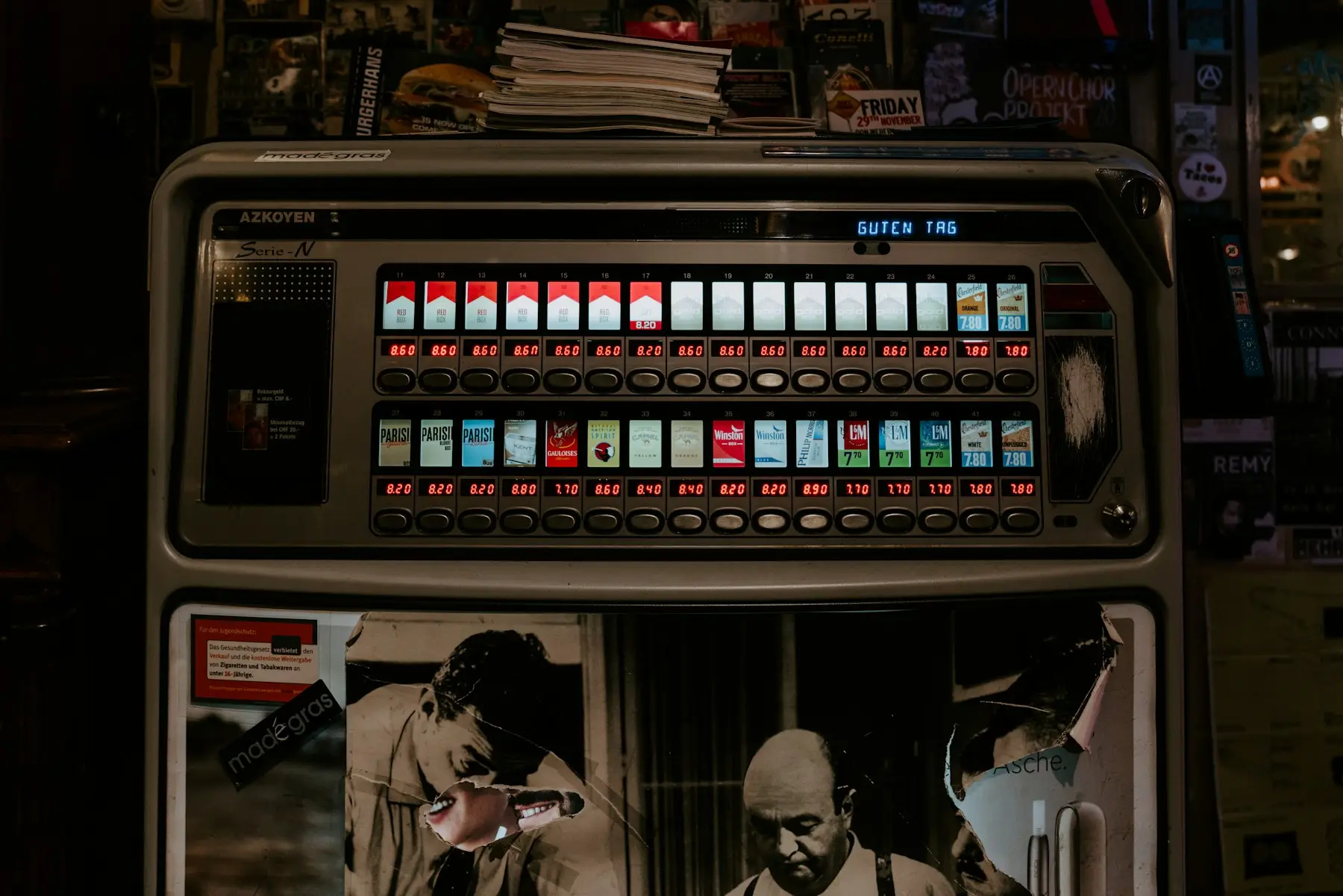
California bans selling cigarettes or any tobacco product from a vending machine, with one exception: a machine inside a bar that holds an on-sale public premises liquor license, at least 15 feet from the entrance (B&P Code §229601). State law defines “tobacco product” to include e-cigarettes and anything made or derived from nicotine (§22950.52), so the same ban covers vapes and nicotine pouches. A machine that does qualify needs its own CDTFA retailer license at $450 a year (CDTFA L-102114). It can sell only unflavored products on the Attorney General’s Unflavored Tobacco List20, and vapes on top of that must be among the e-cigarettes the FDA has authorized.
The rules in one table
| Rule | Source | Effect on a vending machine |
|---|---|---|
| Vending ban with a bar exception | B&P Code §22960 | Allowed only inside a public premises bar, 15 feet or more from the entrance |
| Vapes and nicotine count as tobacco | B&P Code §22950.5 | E-cigarettes, e-liquid, pouches, and their parts are covered |
| Minimum age 21 | Penal Code §308 | Sales to anyone under 21 are a misdemeanor or civil violation |
| Federal vending limit | 21 CFR 1140.14, 1140.16 | Vending only where no one under 21 is present or allowed in, at any time |
| FDA marketing authorization | FDA authorized list | 48 e-cigarettes may be lawfully sold in the U.S. as of August 28, 2026 |
| Flavor ban | H&S Code §104559.5 | No flavored products, menthol included; vending machine operators named |
| Unflavored Tobacco List | H&S Code §104559.1 | Anything not on the list is treated as flavored |
| Retailer license | B&P Code §22972, §22973 | One license per machine, $450 from July 1, 2026 |
| E-cigarette excise tax | CECET (HOPE Act) | 12.5% of the retail price on nicotine vapes, collected at sale |
| Local bans | B&P Code §22960(c) | A city or county can restrict or ban tobacco vending machines outright |
Where state law allows a tobacco vending machine
Section 22960 bans sale from “a vending machine or appliance, or any other coin or token operated mechanical device designed or used for vending purposes.” The statute names machines with remote-control locks, the kind a clerk unlocks for each sale, as covered (§22960(a)1).
The exception in subdivision (b) is narrow. The machine has to be inside a premises licensed by the Department of Alcoholic Beverage Control as on-sale “public premises,” and at least 15 feet from the entrance. The statute defines that distance as within the licensed premises, so a machine outside the door does not qualify (§22960(b)1).
Public premises are places that sell alcohol for drinking on site and do not serve food the way a bona fide restaurant does (B&P Code §230395). A licensee who lets someone under 21 enter and remain there without lawful business commits a misdemeanor (§256656). Restaurants, convenience stores, gyms, hotels, offices, and apartment lobbies are outside the exception.
When a vending machine sells to someone under 21, Penal Code §308 makes the person liable who authorized putting the machine on premises they manage or control, if they knew or should have known people under 21 would use it (PC §308(a)(1)(D)7). For a bar placement, that puts the bar owner on the hook as well as the operator. Before placing a machine in a bar, I’d want the placement agreement to say in writing who checks IDs at the door.
Vapes and nicotine pouches are tobacco products
Under the STAKE Act, a tobacco product is any product containing, made, or derived from tobacco or nicotine and meant for human consumption, any electronic device that delivers nicotine or other vaporized liquids, and any component, part, or accessory of either. FDA-approved cessation products sold only for that purpose are excluded (§22950.5(d)2). AB 3218, in effect from January 1, 2025, extended the definition to synthetic nicotine and nicotine analogs (CDPH18).
So “vape vending machine” and “tobacco vending machine” are the same thing in California law. A machine stocked only with disposables, pods, or pouches falls under §22960 the same as a cigarette machine.
The federal rule: 21 and over, and FDA-authorized products
FDA regulations allow cigarettes and smokeless tobacco to be sold from vending machines only “in facilities where the retailer ensures that no person younger than 21 years of age is present, or permitted to enter, at any time” (21 CFR 1140.16(c)21). The same limit applies to “covered tobacco products,” which include e-cigarettes, under 21 CFR 1140.14(b)(3). Retailers must check photo ID for anyone under 30 (1140.1421).
The FDA lists 48 authorized e-cigarettes and states that “these are the only e-cigarettes that may be lawfully sold in the United States” (FDA22, content current August 28, 2026). They come from Glas, JUUL Labs, Logic, NJOY, and R.J. Reynolds (Vuse). Several are menthol, which California’s flavor ban rules out.
Flavor ban and the Unflavored Tobacco List
SB 793 bans tobacco retailers from selling flavored tobacco products and flavor enhancers. Voters upheld it as Proposition 31 on November 8, 2022, and it took effect December 21, 2022 (CDTFA16). The statute’s definition of a tobacco retailer “includes a person who operates vending machines from which tobacco products are sold,” and a retail location includes any vending machine (H&S Code §104559.5(a)8). “Characterizing flavor” covers fruit, candy, dessert, menthol, mint, wintergreen, and a cooling sensation.
AB 3218 required the Attorney General to publish a list of unflavored brand styles that are legal to sell. Any product not on it “shall be deemed a flavored tobacco product” (H&S Code §104559.1(g)9). The Attorney General published the first list on December 31, 2025 and said enforcement would focus on “obviously flavored” products (California DOJ19). Los Angeles County’s public health department gives January 1, 2026 as the list’s effective date (LA County DPH26). Products are searchable at utl.doj.ca.gov20.
The exemptions (premium cigars at $12 wholesale or more, loose-leaf pipe tobacco, and shisha in 21-and-over hookah lounges) do not cover vapes or pouches (§104559.5(c)–(e)8).
A vape sold from a California machine therefore has to pass two lists: FDA-authorized, and on the Unflavored Tobacco List.
Licenses and taxes
Retailer license, per machine. Under the Cigarette and Tobacco Products Licensing Act, a retail location is “any building from which cigarettes or tobacco products are sold at retail” or “a vending machine” (B&P Code §2297110). Every retail location needs its own license, displayed where the public can see it and renewed every 12 months (§2297211). The CDTFA puts it plainly: two machines in the same bar need two licenses (CDTFA13).
| Application filed | New license, per location | Renewal, per location |
|---|---|---|
| January 1, 2017 – June 30, 2026 | $265 | $265 |
| On or after July 1, 2026 | $450 | $450 |
The increase came from AB 573 (Stats. 2025, ch. 269). The fee is not prorated, and the CDTFA can raise it by regulation to as much as $600 (CDTFA L-102114; §2297312).
California Electronic Cigarette Excise Tax. Since July 1, 2022, retailers collect 12.5% of the retail selling price of e-cigarettes containing or sold with nicotine, on top of sales tax. The retailer needs a CECET account, must include the tax in any price shown on a sign or display, and must give the buyer a receipt that states the tax separately (CDTFA CECET guide16; rate table15). For a vending machine, that receipt requirement means the payment system has to produce a receipt with the CECET line on it. I’d ask the payment provider for a sample receipt showing that line before buying the machine.
Cigarette and tobacco products excise tax. This is paid by the distributor, at $2.87 a pack of 20 cigarettes and 51.08% of wholesale cost for other tobacco products from July 1, 2026 (CDTFA rate table15). Putting untaxed product into a vending machine counts as a distribution, and a retailer cannot hold untaxed product without a distributor license (CDTFA17; CDTFA retailer guide13). Buy from a licensed distributor and the tax is already in the price.
Point-of-purchase sign. Retailers must post a notice at each point of purchase that sales to anyone under 21 are illegal, with the state’s toll-free reporting number (B&P Code §22952(b)4).
The general vending permits and sales tax rules apply too.
Penalties
A machine placed in violation of §22960 is penalized on the same schedule as a sale to someone under 21. The enforcing agency assesses it against whoever sells from the machine, or leases, furnishes, or services it (B&P Code §22958(d)3). The same schedule applies to flavor ban violations (§104559.5(f)8).
| Violation, same location, within 5 years | Civil penalty |
|---|---|
| First | $1,000–$1,500 |
| Second | $2,000–$3,000 |
| Third | $5,000–$10,000 |
| Fourth | $10,000–$20,000 |
| Fifth | At least $20,000 |
For sales to anyone under 21, a third violation at the same location also brings a 45-day suspension of the CDTFA retailer license, a fourth a 90-day suspension, and a fifth revocation (§22958(b)3).
SB 1230 adds $50 per package of seized flavored product, with license suspension on a second violation and revocation on a third (CDPH18). Under Penal Code §308, a business that sells to someone under 21 faces a fine of $500 for a first offense, $1,000 for a second, and $5,000 for any after that. An agency cannot use both the civil penalty and §308 for the same incident (§22958(g)3).
City and county rules
Section 22960 sets a floor. Any city or county can restrict tobacco vending further or ban it, and the local rule controls when the two conflict (§22960(c)1). Some also require a local tobacco retailer license on top of the state one. Two examples:
- San Francisco. Ordinance 140-17 banned flavored tobacco sales, and voters approved it as Proposition E in June 2018. Ordinance 122-19 added Health Code Article 19R. It prohibits any establishment from selling or distributing an e-cigarette that requires FDA premarket review and lacks a marketing order (SF Ordinance 122-1924).
- Unincorporated Los Angeles County. A county Tobacco Retail License is required on top of the state license (LA County DPH26). Since May 1, 2020 the county has banned flavored tobacco sales, menthol included. Its ban also covers flavored vape liquids that contain no nicotine, which goes beyond state law (LA County FAQ25).
Before you place a machine in a bar, check that city’s or county’s code, or call its tobacco control program. In my view that call comes before paying the $450 state license, since the fee is not prorated and the local rule controls.
ID-scanning vending machines
No California statute creates an exception for vending machines that scan IDs or verify age. Section 22960 contains no age-verification provision, and it explicitly covers machines with remote-control locks. Outside a public premises bar, an ID scanner does not make a tobacco vending machine legal under state law. Federal rules likewise tie vending to a facility that keeps everyone under 21 out, and say nothing about a scanner on the machine (21 CFR 1140.16(c)21).
PACT Act
The federal PACT Act treats electronic nicotine delivery systems as cigarettes. It defines a “delivery sale” to include a sale where “the seller is not in the physical presence of the buyer when the buyer obtains possession” (15 U.S.C. §37523). The definitions do not mention vending machines.
Who to call
- CDTFA, for the retailer license, CECET account, and flavored-product seizures: 1-888-334-3300 (CDPH18).
- California Department of Public Health, Office of Youth Tobacco Enforcement, for STAKE Act age rules: 1-800-5-ASK-4-ID (800-527-5443).
- California Department of Justice, for whether a product is on the Unflavored Tobacco List20.
- The city or county tobacco control program or city attorney, for local licenses and bans.
- Department of Alcoholic Beverage Control, to confirm a bar’s license counts as public premises.
The cost of insuring a vending business is a separate question: The Hartford lists tobacco and e-cigarettes as not covered under its typical vending policy.