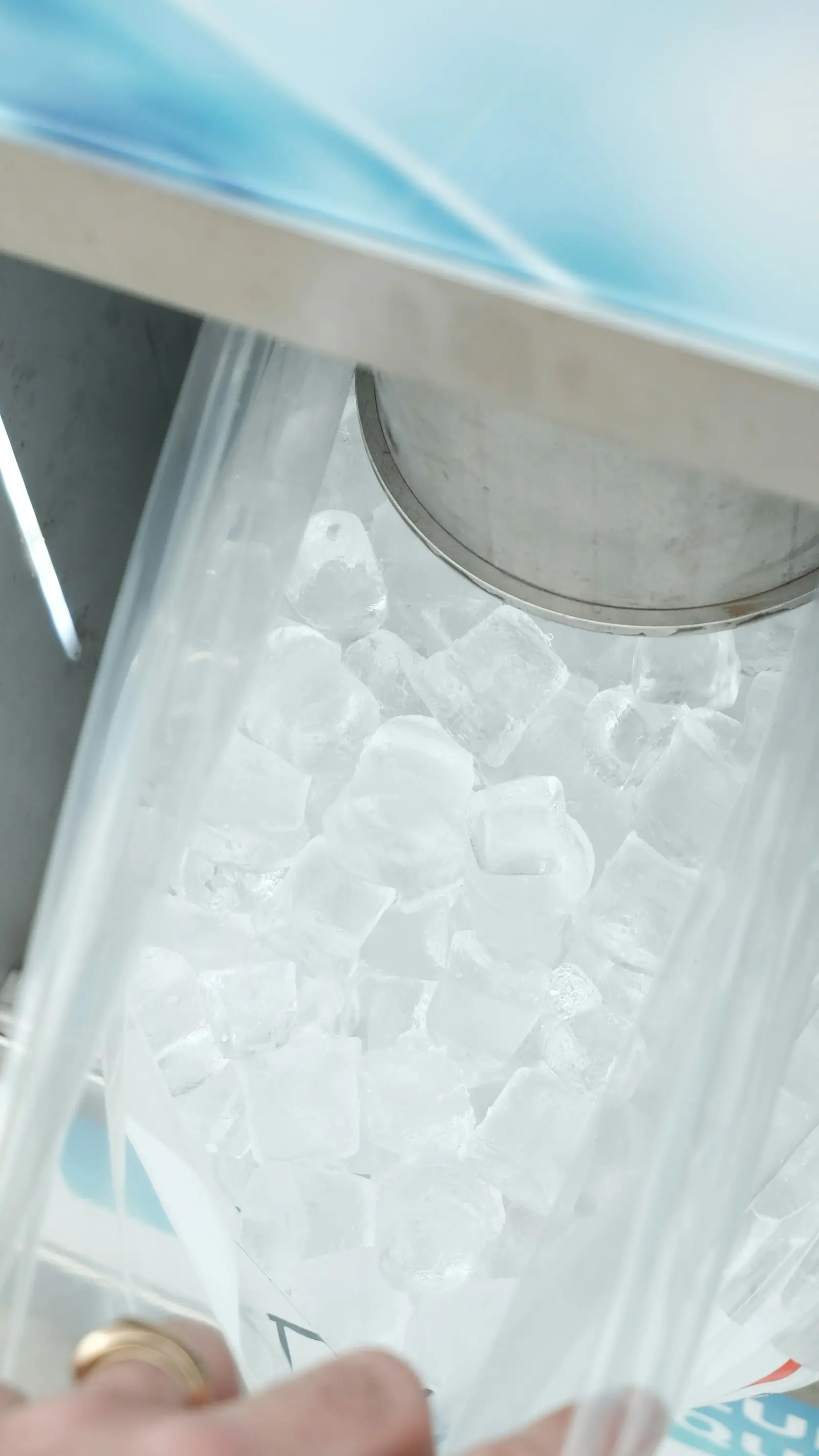
An ice vending machine is a small ice plant with a payment terminal. Kooler Ice’s IM1000 Series III makes up to 1,909 pounds of ice in 24 hours, holds 900 pounds in its bin, and needs a 220V single-phase 60-amp circuit and a 3/4-inch water line (Kooler Ice). None of the three main kiosk makers publishes a machine price: Kooler sends buyers to its sales line (Kooler Ice), and Everest and Ice House America list no prices on their product pages (Everest, Ice House America).
The rules are closer to a food plant than to a snack machine. The FDA regulates packaged ice as a food, and states license the small producers it does not inspect (FDA). Texas, Florida, and Louisiana each have a rule that reaches an ice kiosk.
The machines and what they need
| Machine | Daily output, per maker | Storage | Power | Water | Footprint |
|---|---|---|---|---|---|
| Kooler IM1000 Series III | Up to 1,909 lb; 140 ten-lb bags from a full bin | 900 lb | 220V, 1-phase, 60A | 3/4” line | 58.75” W × 78.3” D × 113.5” H |
| Kooler IM600XL | 80+ ten-lb bags from a full bin | 550 lb | 220V, 1-phase, 60A | 3/4” waste-water line | 72” W × 36” D × 109” H |
| Everest Summit | Up to 1,077 lb (Pro 1,553 lb, Max 1,909 lb) | 550 lb | 208–230V, 1-phase, 50A | 1/2” line, 3/4” drain | 45” W × 55” D × 93.5” H |
| Ice House America Ice Merchant | Up to 320 ten-lb bags | 750 lb | Not published | Filtration and softener; RO optional | 6 ft × 4 ft, 8 ft 5 in tall |
| Ice House America Ice Kiosk | Up to 450 bags | 2,400 or 3,000 lb | Not published | Not published | 80 or 110 sq ft |
Kooler’s IM600XL page repeats the IM1000’s 1,909-pound output figure and gives the water line as both 3/4 and 1/2 inch (Kooler Ice). Ask Kooler for a spec sheet before you size the plumbing. Ice House America’s larger Ice House building runs two ice makers and is rated at up to 1,300 bags a day (Ice House America).
All of these take cards. Kooler includes a card reader and accepts cash, coin, Apple Pay, and Google Wallet (Kooler Ice). Everest includes a card reader and offers a bill and coin acceptor and a Nayax DOT as options; its Summit can also vend from 0.025 to 5 gallons of water (Everest). Everest introduced the Summit in January 2024 with a Bluetooth app called ICELINQ (Vending Times).
Site work before the machine arrives
Kooler’s FAQ calls for a 3/4-inch water line and 220V single-phase power, and advises a concrete pad with bollards, plus tie-downs in some areas (Kooler Ice). Everest says the Summit needs no custom concrete pad, crane, or general contractor (Everest); that is the maker’s claim, and your city’s permit office decides what it requires. A North Carolina tax ruling quotes one operator saying its ice houses were permitted as modular manufacturing units under the state building code (NCDOR).
That makes the lease different from a snack machine placement. You are asking a landlord for a parking-lot pad, a 60-amp circuit, a water tap, and a drain. I’d get the electrician’s and plumber’s quotes and the landlord’s written consent before signing for a machine, because none of the makers price that work.
Everest’s comparison page puts competitors’ extras at $5,000 to $10,000 for reverse-osmosis add-ons, at least $4,000 for setup, and over $1,000 for card readers (Everest). Those are one maker’s figures about its rivals. They are useful as a list of line items to ask every seller about.
Running costs
Makers publish no dollar figures for electricity, water, filters, or maintenance. The ice maker inside the Kooler IM1000 is a Scotsman C1848 (Kooler Ice), and Scotsman’s spec sheet for the air-cooled C1848MA-32 gives 4.48 kWh and 18.0 gallons of water per 100 pounds of ice, tested at 90°F air and 70°F water (Scotsman). That covers the ice maker only, not the bin, bagger, lights, or payment terminal.
To get a floor for your own site, multiply those figures by your local electric and water rates. At a full 1,909 pounds a day, the ice maker alone would use about 85.5 kWh and 344 gallons. Hot weather pushes both up.
Prices per bag and per gallon are set locally, and we did not find a current published price list from an operator or maker to cite.
Financing
Kooler lists three financing partners: Taycor, for applications up to $300,000; CapCity Finance, up to $350,000 with no early payoff penalty; and Ascentium Capital, a Regions Bank company, with terms up to 72 months and no down payment required (Kooler Ice). No rates are published. For how these terms compare with an SBA loan, see vending machine financing.
Kooler’s own ROI page says there is no guaranteed payback period and individual results will vary (Kooler Ice). In my view, that sentence matters more than any revenue example on a maker’s site, since none of them publishes the machine price you would be paying back.
Licensing by state
The FDA regulates packaged ice in interstate commerce as a food, made under current good manufacturing practice and labelled with the producer’s name, place of business, and net quantity. It does not inspect small producers that sell only within their state, such as retail stores; state and local agencies regulate those (FDA).
| State | Rule | What it requires |
|---|---|---|
| Texas | DSHS Food Manufacturer license | Required to package ice for self-service retail sale (DSHS); “Ice Vending Machine” is a listed manufacturer type (DSHS). Water vending machines are licensed one by one (DSHS) |
| Florida | Fla. Admin. Code R. 5K-4.023 | Permitted as a packaged ice plant with an approved commissary under an annual agreement; clean and sanitize every two weeks; backflow prevention; coliform testing each quarter, which can move to every six months after three clean quarters; bags labelled under 21 CFR 101; records kept two years (5K-4.023) |
| Louisiana | LAC Title 51, Part VI, Chapter 13 | Make and model on the Department of Health’s approved list; a Certificate of Registration with bag artwork for bagged ice; approval for a water source that is not a listed public system (LDH) |
| California | Water Vending Machine Operator License | For water vending: an annual license at $60 per machine, coliform test results, and photos of the English and Spanish consumer notices (CDPH, CDPH 8604). We did not find a California rule specific to ice kiosks |
| Arizona | Ariz. Admin. Code R18-4-216 | For water vending: clean to the maker’s recommendations, test for total coliform at least every six months, keep records one year (R18-4-216) |
A kiosk that sells both ice and water can fall under two programs. Call your state food safety office with the make and model before you order. For the general business registrations every route needs, see vending business license and LLC.
Water quality and the trade group
KCUR reported in March 2026 on a University of Iowa study that found lead in water from ice and water kiosks across six states; Kooler Ice was one of the brands tested (KCUR). In April 2026 the International Packaged Ice Association, whose members include bagged-ice plants that compete with kiosks, called for kiosks to be regulated (IPIA).
I’d expect more inspection of kiosks, not less, and would budget for regular water testing even in a state that does not require it.
Sales tax on vended ice
| State | Treatment |
|---|---|
| Missouri | Ice sold from vending machines gets the reduced food rate under §144.014 RSMo (LR 8377) |
| Colorado | Water and ice from a vending machine treated as exempt food; general information letters are not binding (GIL-18-011) |
| North Carolina | Food sold through a vending machine is taxable; ice houses bought to make ice for sale are subject to sales or use tax at the 4.75% state rate plus local rates (NCDOR) |
For how vending sales tax works more broadly, see running a vending route.
Market size
The most recent industry figure we found is from 2006, when the IPIA’s executive director put the packaged ice industry at $2 billion to $2.5 billion a year (Packaging Strategies). Kooler’s site repeats a $2.5 billion figure without a source. We found no current IPIA number.