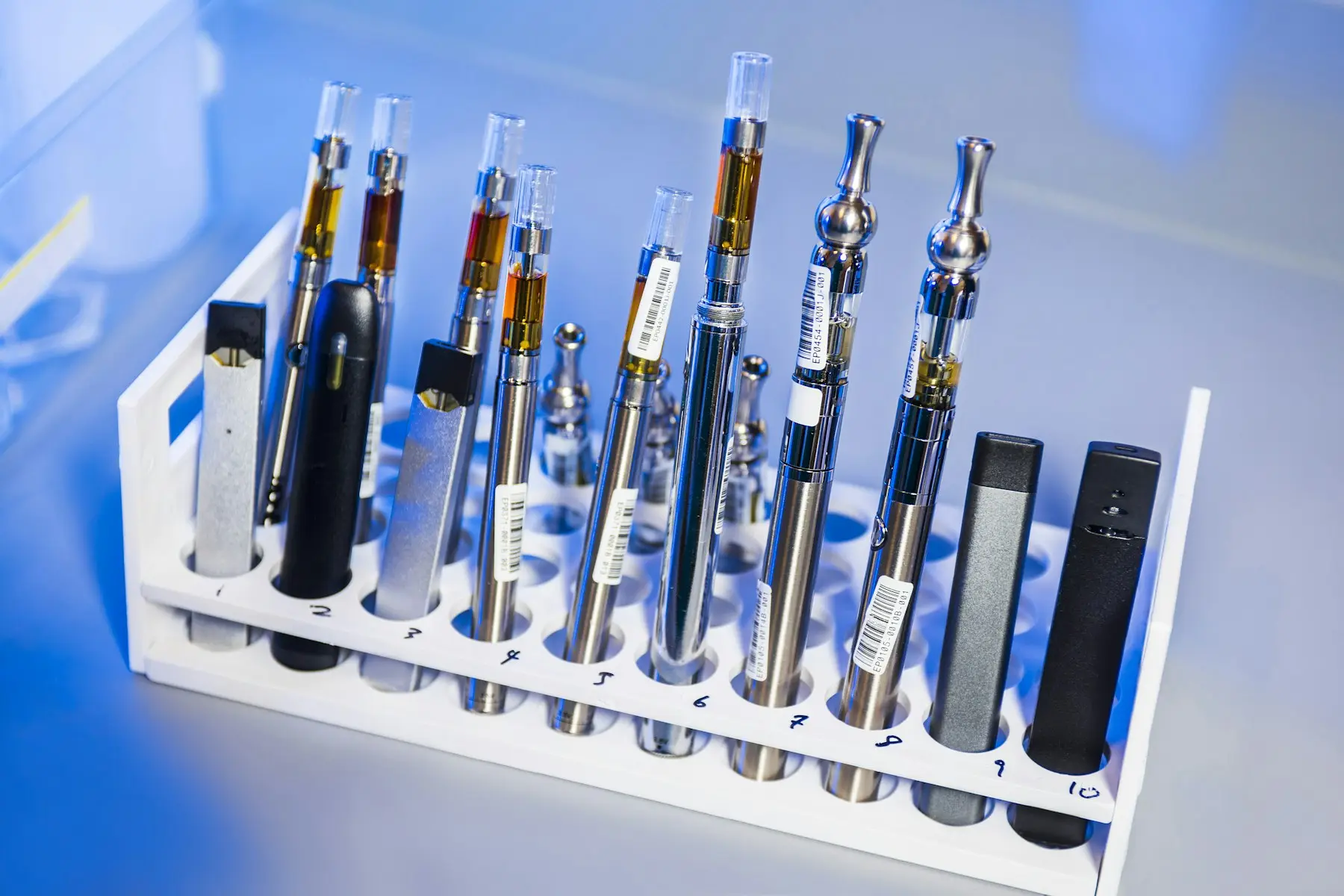
Federal rules allow e-cigarettes to be sold from a vending machine only “in facilities where the retailer ensures that no person younger than 21 years of age is present, or permitted to enter, at any time” (21 CFR 1140.14(b)(3)). Every state then adds its own rule. Six states ban vape vending outright, Virginia’s ban is in question after a rewrite that took effect October 1, 2026, and most of the rest allow machines only in bars, tobacco shops, or premises closed to anyone under 21. The table below gives the rule and the statute for all 50 states and DC.
This is general legal information. Statutes change, and several in the table were amended in 2025 and 2026, so confirm the current rule with the state agency before you buy a machine. Machine prices and age-verification hardware are covered in vape vending machines.
The federal rule
Vending is limited to 21-and-over facilities. FDA’s retail rules in 21 CFR Part 1140 split products into two groups. For cigarettes and smokeless tobacco, sales must be face to face, and vending machines are allowed only where no one under 21 is present or permitted to enter at any time (§1140.16(c)). For “covered tobacco products,” §1140.14(b)(3) bars sales “with the assistance of any electronic or mechanical device (such as a vending machine)” except in the same kind of facility (§1140.14). The regulation defines a retailer to include anyone “who operates a facility where vending machines or self-service displays are permitted” (§1140.3).
E-cigarettes are covered tobacco products. A covered tobacco product is any tobacco product deemed subject to the Food, Drug, and Cosmetic Act (§1140.3). The 2016 deeming rule, effective August 8, 2016, brought e-cigarettes and every other product meeting the statutory definition under FDA authority, except accessories (81 Fed. Reg. 28974; 21 CFR 1100.2). Since a 2022 amendment, the statutory definition reaches products “containing nicotine from any source,” so synthetic-nicotine vapes are included (21 U.S.C. §321(rr)).
The minimum age is 21. The President signed Tobacco 21 on December 20, 2019, raising the federal sales age from 18 to 21 for all tobacco products, e-cigarettes and e-liquids included. FDA’s final rule moved the vending and photo-ID provisions to 21 and 30 from September 30, 2024 (FDA). Retailers must check photo ID with a date of birth for any buyer, and the check can be skipped only for people over 29 (§1140.14(b)(2)).
The product needs FDA authorization. FDA’s list of authorized e-cigarettes says “these are the only e-cigarettes that may be lawfully sold in the United States” (FDA). A machine that is legally placed can still be selling illegal stock.
The PACT Act. The PACT Act counts electronic nicotine delivery systems as cigarettes and regulates “delivery sales,” meaning remote orders or sales where the seller is not physically present when the buyer takes possession (15 U.S.C. §375). Its definitions do not mention vending machines, and no federal source found here applies it to a machine on site.
The federal rule is written around the facility. Several states (Arkansas, Kentucky, Missouri, North Carolina, Ohio, Tennessee) allow a machine in a public space if staff supervise it or unlock it for each sale. Those state options do not remove the federal requirement. In my view a small operator should plan every placement around a venue that keeps under-21s out, whatever the state statute allows.
State-by-state table
“Yes” in the vapes column means the state’s vending provision, or the definition it relies on, names e-cigarettes, vapor products, or electronic smoking devices. Where a state’s rule covers only cigarettes or tobacco, the federal 21-and-over facility rule still applies to vapes. Statutes checked October 2026.
| State | State vending rule | Vapes covered | Source |
|---|---|---|---|
| Alabama | Banned for vapes, e-liquids, and alternative nicotine products from June 1, 2025 | Yes | HB8 (2025) |
| Alaska | Bar, club, or package-store premises, away from the main entrance and continually supervised by an employee; or a non-public employee break room with a warning sign | Yes | AS 11.76.109 |
| Arizona | Tobacco machines only in a bar, or an employee lounge closed to the public at a business that employs no minors; sign required | No. No vape vending rule found | A.R.S. §36-798.02 |
| Arkansas | Not in a public place, except a restricted non-public area, 21+ on-premises alcohol premises, or under supervision of the owner or an employee; sign on each machine | Yes | Ark. Code §5-27-227 |
| California | Only inside a bar licensed as public premises, at least 15 feet from the entrance. Full California rules | Yes | B&P Code §22960 |
| Colorado | Banned for tobacco products, nicotine products, and e-cigarettes; cigarettes only in the age-restricted area of a licensed gaming establishment | Yes | C.R.S. §44-7-103 |
| Connecticut | Cigarette machines only in a separate 21+ area of a liquor-permit premises; vapes by employee-assisted sale only, unless the premises bar under-21s | Yes | §21a-416, §12-289a |
| Delaware | Taproom, tavern, tobacco shop, or premises that exclude under-21s; at least 25 feet from any entrance and visible to the owner or supervisor | Yes | 11 Del. C. §1119 |
| District of Columbia | Licensed tavern, nightclub, or restaurant, or a 21+ establishment; in plain view and control of an employee | Yes | D.C. Code §47-2404 |
| Florida | Lockout device the dealer or an employee activates for each sale, one product at a time; not required where under-21s are barred. Florida permits | Yes | Fla. Stat. §569.37, §569.007 |
| Georgia | Vapor products face to face only, which the Department of Revenue reads as no vape vending anywhere; tobacco machines in places not readily accessible to under-21s or under continuous employee supervision. Georgia permits | Banned | SB 375, DOR |
| Hawaii | Cigarette machines only in a bar, cabaret, or 18+ establishment; tobacco products face to face except in retail tobacco stores, bars, and 18+ venues | Yes, §328J-18 | HRS §328J-16, §328J-18 |
| Idaho | Banned: no sales of tobacco products or electronic smoking devices from vending machines | Yes | Idaho Code §39-5706 |
| Illinois | Only where under-21s are not permitted access at any time, or on-premises alcohol venues under direct owner or manager supervision. Illinois permits | Yes | 720 ILCS 675/1 |
| Indiana | Only 21+ areas of licensed premises, 21+ private workplaces, 21+ private clubs, and riverboats; never at an entrance or in a common area | Yes | IC 35-46-1-11.5 |
| Iowa | Only where no one under 21 is present or permitted to enter at any time | Yes | Iowa Code §453A.36 |
| Kansas | Not in any area open to minors, except behind a counter, areas minors are barred from by law, or closed workplaces for adult employees | Yes | K.S.A. 79-3321 |
| Kentucky | In the cashier’s line of sight, except factories and bars or taverns minors cannot enter | Yes | KRS 438.315 |
| Louisiana | Only where under-21s are denied access, or in a facility with no one under 21 present, in the unobstructed line of sight of the dealer or an employee | Yes | La. R.S. 26:910 |
| Maine | Banned: the state may not license vending sales, and sales must be face to face (P.L. 2025, c. 367) | Yes | 22 M.R.S. §1551-A |
| Maryland | Only in establishments that under-21s are prohibited by law from entering at any time | Yes | Bus. Reg. §16-3A-02 |
| Massachusetts | No venue rule; fine for letting anyone under 21 use a machine, and a state notice on each machine | Not confirmed | ch. 64C §10 |
| Michigan | Not in public places open to minors; cigarette-only machines in Class C bars under adult supervision, or non-public areas 20 feet from public entrances | Not confirmed | MCL 750.470 |
| Minnesota | Only in facilities that under-21s cannot enter at any time | Yes | Minn. Stat. §461.18 |
| Mississippi | Only in places that deny entry to under-18s or require them to be with an adult | No. No vape vending rule found | Miss. Code §97-32-15 |
| Missouri | In the line of sight of a supervising adult, or with a lockout device allowing one sale per activation; exceptions for under-18-barred, non-public places | Yes | RSMo §407.931 |
| Montana | Only where alcohol is sold for on-site drinking, in the line of sight of the owner or an employee | Yes | MCA §16-11-306 |
| Nebraska | Banned except places not open to the public and the room where alcohol is served at on-premises liquor licensees | Yes | Neb. Rev. Stat. §28-1429.02 |
| Nevada | Cigarette machines in public areas only where under-21s are barred from loitering | No. No vape vending rule found | NRS 202.2494 |
| New Hampshire | No vending-specific placement rule found; whoever monitors the machine must check ID for buyers who look under 21 | Yes | RSA 126-K:3 |
| New Jersey | No vending-specific placement rule found; sales to under-21s by a machine are banned | Yes | N.J.S.A. 2A:170-51.4 |
| New Mexico | Only age-controlled locations where minors are not permitted | Yes | SB 131 (2020) |
| New York | Bars, bar areas of restaurants with a full liquor licence, private clubs, tobacco businesses, and supervised non-public workplaces. New York permits | Yes | PHL §1399-dd |
| North Carolina | 18+ establishments, or under continuous employee control and activated for each purchase | Yes | G.S. 14-313 |
| North Dakota | Areas under-21s may not enter, or a device that requires a salesperson to control dispensing | Yes | §12.1-31-03.1 |
| Ohio | Areas not open to the public, areas under-21s are not generally permitted, or in the immediate vicinity, plain view, and control of staff with a posted notice. Ohio permits | Yes | R.C. 2927.02 |
| Oklahoma | Areas of businesses not open to the public, and public places that do not admit under-21s | Yes | 63 O.S. §1-229.17 |
| Oregon | Only premises permanently and entirely off-limits to under-21s | Yes | ORS 167.780 |
| Pennsylvania | No venue list; a machine may not be placed in a location accessible to minors. Pennsylvania permits | Yes | 18 Pa.C.S. §6305 |
| Rhode Island | Continuously supervised, in direct line of sight, with an electronic lock released by staff; no lock needed in 21+ alcohol premises | Yes | R.I. Gen. Laws §11-9-13.1 |
| South Carolina | 18+ establishments, or under continuous employee control, activated for each purchase | Yes | S.C. Code §16-17-500 |
| South Dakota | Through 2026, places that deny under-21s access at all times. From January 1, 2027, only 21+ areas of licensed alcohol establishments, with an age-verification system on the machine | Yes | §34-46-2, §10-50E-8 |
| Tennessee | Places not open to the public or that deny entry to under-21s; supervised and locked machines in bars; elsewhere under continuous supervision or by token bought from staff | Yes | Tenn. Code §39-17-1507 |
| Texas | Only in a business, cigar humidor area, or package store never open to under-21s. Texas permits | Yes | H&S Code §161.086 |
| Utah | Only in a separate area of the premises that under-21s may not enter without a parent or guardian | Yes | Utah Code §76-10-105.1 |
| Vermont | Banned: “All vending machines selling tobacco products are prohibited” | Yes | 7 V.S.A. §1003 |
| Virginia | Banned through September 30, 2026, vapes included. The version in force from October 1, 2026 bans vending of “tobacco products” as defined in §58.1-1021.01, a definition that does not name nicotine vapor products | Unclear from October 1, 2026 | Va. Code §18.2-371.2 |
| Washington | Tobacco machines only inside premises closed to under-21s or at industrial worksites with no employees under 21, 10 feet from entrances | Not confirmed | RCW 70.155.030 |
| West Virginia | Only where under-21s are not permitted, or Class A alcohol licensees under ABC rules | Yes | W. Va. Code §16-9A-8 |
| Wisconsin | Tobacco machines only where no one under 18 is present unless with a parent or guardian; not within 500 feet of a school | No. No vape vending rule found | Wis. Stat. §134.66 |
| Wyoming | Workplaces not open to the public, places that bar under-21s, and bars that bar under-21s; sign on each machine | Yes | Wyo. Stat. §14-3-303 |
Some state statutes in the table still use 18: Hawaii, Mississippi, North Carolina, South Carolina, and Wisconsin. The federal minimum of 21 applies in every state regardless.
Notes on specific states
Virginia. The ban in force until October 1, 2026 covered “retail tobacco products,” defined to include any electronic smoking device and any nicotine vapor product. The rewritten section bans vending of “tobacco products” as defined in §58.1-1021.01 (Va. Code §18.2-371.2). That definition lists cigars, smokeless tobacco, pipe tobacco, and loose leaf tobacco, and defines nicotine vapor products separately (§58.1-1021.01). No replacement vape vending rule was found. I would not place a vape machine in Virginia without a written answer from Virginia ABC.
Georgia. Georgia’s tobacco vending section still lists places a machine can go, and names vapor products. SB 375 separately made vapor sales unlawful “by any means other than an in-person, face-to-face sale” (SB 375). The Department of Revenue’s FAQ reads that as a statewide ban on vape vending (Georgia DOR).
Alabama. HB8 (2025) is titled as an act “to prohibit the distribution of tobacco, tobacco products, electronic nicotine delivery systems, e-liquids, and alternative nicotine products through a vending machine” (HB8). The convenience-store trade group NACS reported it as a ban on vape sales in vending machines, along with limits on which vapes convenience stores can stock (NACS).
Texas. Section 161.086 counts the owner of a vending machine as a retailer and lets machines in the wrong place be seized, sealed, or disabled (§161.086). The Comptroller says “an e-cigarette retailer permit cannot be obtained for a vending machine.” The permit attaches to the place of business at $180 for a two-year period, or $90 for a retailer that already holds a cigarette, cigar, or tobacco permit (Texas Comptroller). The general Texas operator permits are in Texas vending machine permits.
States with tobacco-only rules. Arizona, Mississippi, Nevada, and Wisconsin write their vending rule for cigarettes or tobacco products and define vapor products separately (A.R.S. §36-798; Wis. Stat. §134.66). In those states the federal 21-and-over facility rule is the main limit on a vape machine. Washington’s vapor chapter has no vending section but bans self-service displays of vapor products (RCW 70.345). I think a machine there carries the same risk as a self-service display, and I’d ask the Liquor and Cannabis Board before placing one.
Age verification
The federal photo-ID rule applies to vending sales the same as counter sales: photo ID with a date of birth for anyone 29 or younger (21 CFR 1140.14(b)(2)). In a 21-and-over facility the venue’s door check is what keeps the machine compliant.
State rules that go further:
- Tennessee. Staff must ask for proof of age from anyone who may reasonably appear under 50 (§39-17-1507).
- New Hampshire. Whoever monitors sales from a tobacco vending machine must check ID for any buyer who does not appear to be at least 21 (RSA 126-K).
- South Dakota. From January 1, 2027, every nicotine vending machine needs an age-verification system, and buyers must pass it to purchase (SDCL §10-50E-8). The machine must still be in a 21-and-over area of a licensed alcohol establishment.
- Lockout states. Florida, Missouri, North Carolina, North Dakota, Rhode Island, and South Carolina recognize a machine that staff unlock for each sale (Fla. Stat. ch. 569; R.I. Gen. Laws §11-9-13.1).
No statute in this review lets an ID scanner on the machine stand in for the venue rule. California’s statute names remote-control locking machines as covered by its ban (B&P Code §22960), and its one exception is a bar licensed as public premises (California vape vending rules). I’d treat an ID-scanning machine as an extra check inside a 21-and-over venue, since the federal text is about who can enter the facility.
Flavor bans that limit what a machine can stock
Statewide bans on flavored vapes:
| Jurisdiction | Rule | Menthol | Source |
|---|---|---|---|
| California | No flavored tobacco products; anything off the Attorney General’s Unflavored Tobacco List is treated as flavored | Banned | H&S Code §104559.5 |
| District of Columbia | All flavored tobacco banned; no e-cigarette sales within a quarter mile of a middle or high school | Banned | D.C. Code §7-1721.08 |
| Massachusetts | Flavored tobacco products banned except for on-site use in a licensed smoking bar | Banned | ch. 270 §28 |
| New Jersey | Vapor products with any flavor other than tobacco banned, including from a retailer’s vending machine | Banned | P.L.2019, c.425 |
| New York | Flavored vapor products banned; FDA-authorized products exempt | Banned | PHL §1399-mm-1 |
| Rhode Island | Flavored ENDS products banned from January 1, 2025 | Allowed | §44-20-61 |
| Utah | Flavored e-cigarette products banned from January 1, 2025, as are products without FDA authorization or a pending application | Not stated in this review | Utah Code §76-10-113 |
Many cities and counties have their own flavor bans, so the state list is a floor.
Licences and taxes that apply to a machine
Licences found in this review that attach to each machine, or to each location with a machine:
| State | Licence | Fee | Source |
|---|---|---|---|
| California | CDTFA retailer licence for each machine | $450 a year | CDTFA L-1021 |
| New York | Vapor Products Dealer Certificate of Registration for each vending machine | $300 a year, plus a 20% supplemental tax on vapor sales | NY Tax Department |
| District of Columbia | Vending machine operator’s licence for each machine | $15 a year | D.C. Code §47-2404 |
| Kansas | Operator master licence plus a permit for each machine | Master licence free; $25 a machine per biennium | K.S.A. 79-3304 |
| Louisiana | Vending machine operator permit plus a permit for each machine | $75 a year; $5 a machine | ATC application |
| South Dakota | Licence for each vending machine, from January 1, 2027 | $100 a machine | SDCL §10-50E-6 |
| Kentucky | Tobacco, nicotine, or vapor product licence for each premises, from July 1, 2026 | $500 a year plus $50 application | KRS 438.3063 |
| Indiana | Tobacco sales certificate for each location, including a premises with a cigarette vending machine | $200 | IC 7.1-3-18.5 |
| Connecticut | ENDS dealer registration with the Department of Consumer Protection | $75 application plus $800 a year | Conn. Gen. Stat. §21a-415 |
| Pennsylvania | Department of Revenue vending machine licence | $25 per vending location | PA Revenue |
| Wisconsin | Local retail licence from the city, village, or town clerk, per premises | $5 to $100 a year | Wis. Stat. §134.65 |
New York also registers each cigarette or tobacco machine with the Tax Department at $100 a year, and that registration does not cover vapor products (NY Tax Department). Pennsylvania’s page does not say whether “location” means each machine or each site. In my view per-machine fees like New York’s $300 matter more to a one- or two-machine operator than to a larger one, since there is no volume to spread them over.
The general business registrations every operator needs are covered in vending machine business license and LLC.
Before you place one
- 1Read the state statute in the tableCheck the current version on the legislature site, and call the state agency that licenses tobacco retailers if the section was amended in 2025 or 2026.
- 2Check the city and countyMany local governments ban tobacco vending, ban flavors, or require their own retail licence on top of the state one.
- 3Confirm the venue keeps under-21s out at all timesThe federal rule covers the whole facility, at every hour. A bar that admits all ages for lunch or events does not meet it.
- 4Put the door check in the placement agreementSay in writing who checks IDs at the entrance and where the machine sits, including any distance from the door the state sets.
- 5Get the licences before stockingApply for any per-machine or per-location tobacco or vapor licence and display it on the machine where the state requires.
- 6Check every product against the listsEach vape must be on the FDA authorized list, and in a flavor-ban state it must also meet the state rule.
On the venue, see how to find vending machine locations for where machines go, and placement agreement terms for what to put in writing. On insurance, The Hartford lists tobacco and electronic cigarettes as not covered under its typical vending policy (The Hartford); more on that in vending machine insurance cost.