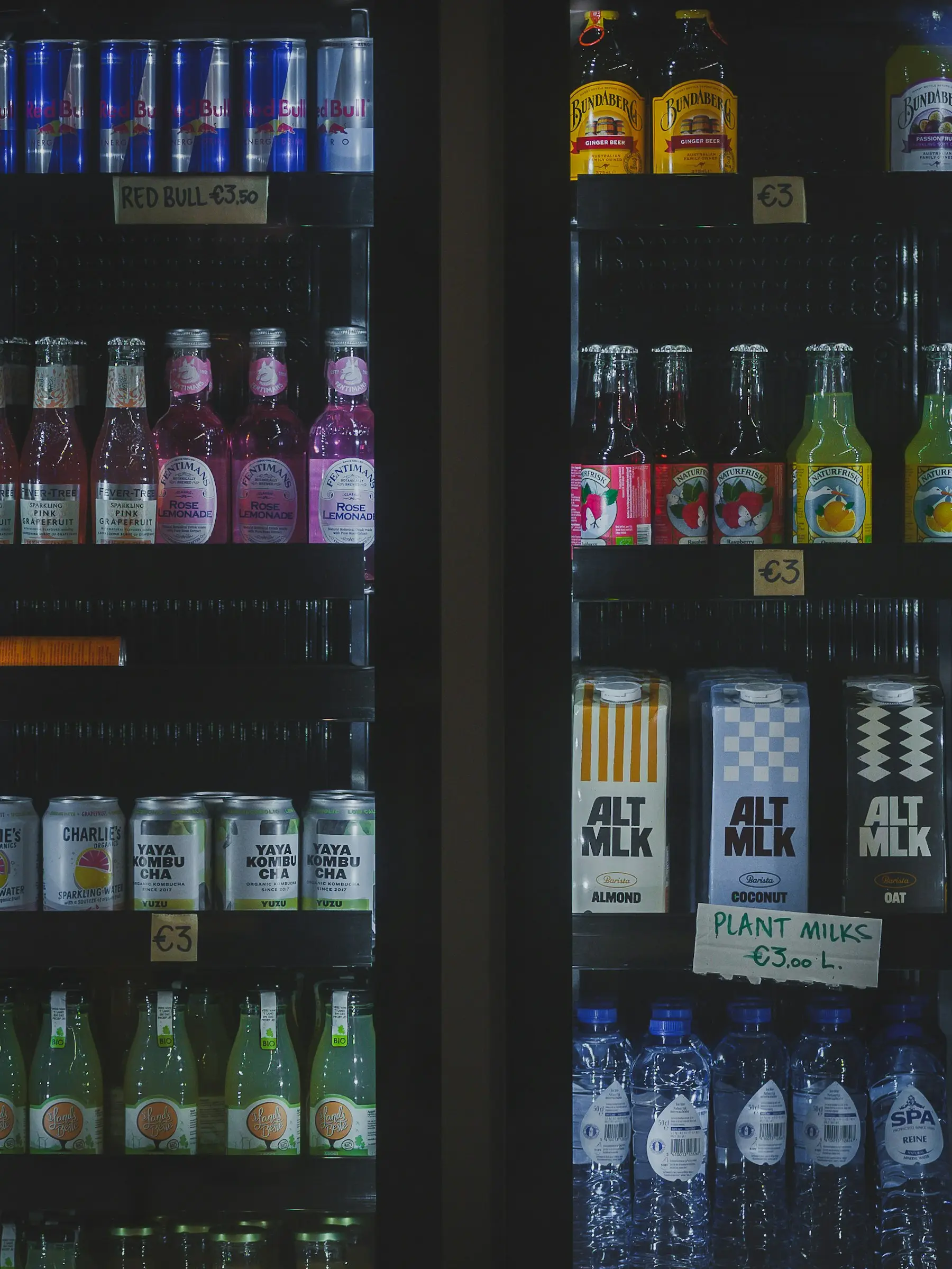
A Byte Smart Fridge cost $5,500 on October 3, 2026, and every kiosk pays $125 a month, 2.5% + $0.20 per transaction, and $0.15 for each RFID tag on the items it sells (pricing1). Byte acts as merchant of record, so card payments run through Byte and it pays you out once a month.
Prices
| Kiosk | Temperature range | Standard size | XL size |
|---|---|---|---|
| Smart Fridge | 35°F to 40°F | $5,500 | $7,000 |
| Smart Cabinet (ambient) | 45°F to 75°F | $5,500 | $7,000 |
| Smart Freezer | −10°F to 5°F | $5,500 | Not offered |
From Byte’s pricing page1, checked on October 3, 2026. Buying three or more saves $500 per kiosk, which makes a standard kiosk $5,000 and an XL $6,500. Freight is not mentioned on the pricing page. Leasing and financing are not published.
Fees and payouts
- $125 a month per kiosk for the online dashboard. Byte lists onboarding, the help desk, monthly client roundtables, and email and phone support under this fee.
- 2.5% + $0.20 per transaction. Byte is the merchant of record, and the pricing page lists Google Wallet, Apple Pay, and EMV cards.
- $0.15 per RFID tag, one on every item.
- Monthly payouts. Byte processes remittances on the 5th business day of the month and says the deposit takes 2 to 3 business days to reach your bank (schedule5). Tag fees and any open invoices come out of the remittance.
- Cellular. The spec sheet2 lists “Cellular or Ethernet” connectivity. A cellular fee is not published.
Micromart’s comparison page16 states Byte’s processing as 2.5% + $0.35. That is a competitor’s figure, and it does not match the $0.20 on Byte’s own pricing page1. Its $125 monthly fee and $7,000 XL price match Byte’s.
On $500 of monthly sales across 200 purchases, Byte’s published fees come to $125 + $12.50 + $40 = $177.50. Tags add at least $30 more if each purchase is a single item. At Micromart’s stated $0.35, the fixed per-transaction part would be $70 instead of $40, and the month $207.50. Smart cooler monthly fees puts that month next to the other platforms.
RFID tags
Every product carries a Byte-supplied sticker that shelf sensors read. You order tags in the Byte dashboard in multiples of 100, from 100 up to 4,000 on one roll, at $0.15 each, and the cost comes off your monthly remittance (tag FAQ3). There are four types: a regular tag for sandwiches, salads, and snacks, a drink flag for liquid-filled bottles and jars, a microwave-safe tag for heatable containers, and a metal flag for cans.
Shipping is charged after the order is filled. Byte gives a general range of $17 to $50 for FedEx Ground and $50 to $200 for FedEx Overnight. Pickup in Petaluma, California, is free. The tag FAQ says printing takes 1 to 3 business days and calls the pickup point an office; a separate article4 says 1 to 2 business days and calls it a warehouse.
How smart coolers detect items covers how RFID compares with cameras and weight trays, and why liquids and metal need special tags.
How a sale is charged
The shopper taps a card or badge, the door unlocks, and the kiosk compares the tags it can read before and after the door closes.
- Hold. On current EMV and tap readers the pre-authorization defaults to $15.00. On older swipe-only readers it is fixed at $1.00. The hold article6 says to ask Byte support to change it, and also gives dashboard steps with a minimum of $1.00. The hold drops off when the transaction processes, or within 7 business days if nothing was bought. Pre-authorization holds compares other platforms.
- Offline. A kiosk can sell for up to 96 hours without a connection and processes the sales once it reconnects. After 96 hours the door stops letting people transact. Offline, it cannot run what the offline article9 calls “the usual $1.00 preauthorization”, a figure that differs from the $15.00 default above.
- Mischarges. Byte puts its fleetwide average at “about 0.4% of total transaction volume” (mischarge article7). A mischarge happens when a tag cannot be read at door close, and the shopper is charged for an item still in the kiosk. Byte names tagging, merchandising, and other kiosks nearby as the causes. The figure is Byte’s own and has not been independently verified.
- Theft. Byte’s home page14 calls the kiosks “theft-proof”. Its help desk13 recommends a surveillance camera near the store, signage, and regular inventory audits.
The 41°F lockdown
Byte has a setting that locks the store when the temperature in its 10-minute status reports stays above 41°F for more than 30 minutes (NAMA article8). You ask Byte support to turn it on. Once it trips, nobody can buy until someone goes to the kiosk, checks the temperature, and logs in to restock. The store reopens after three consecutive readings under 41°F. Byte says some US health departments require this kind of certified lockdown, so check yours before you stock fresh food.
Specs and payments
| Kiosk | Size (W × D × H, in) | Shelves | Weight |
|---|---|---|---|
| Smart Fridge, Smart Cabinet | 24.25 × 23.25 × 79 | 4, 19.5 W × 17.5 D | 175 lb |
| Smart Freezer | 27 × 33 × 79 | 4, 23.5 W × 27 D | 175 lb |
| XL Fridge, XL Cabinet | 27.5 × 30 × 83 | 4, 23 W × 23.5 D | 250 lb |
From Byte’s spec sheet2. Every model lists 110 V, 60 Hz, 4 A, a NEMA 5-15P plug, and 6 kWh per 24 hours. Item capacity is not published.
Byte integrates with campus card systems from Atrium, CBORD, Illumia (formerly Transact), and TouchNet, and with payroll deduction by employee badge (campus card FAQ10). Those kiosks get a second reader and still take credit cards. Byte does not publish whether it supports cash, EBT, or age verification.
Warranty, support, and delivery
Every kiosk comes with a one-year parts and service warranty. Byte says its support team sends a technician when needed and quotes out-of-warranty costs before doing the work (pricing1).
Support runs Monday to Friday, 6 AM to 4 PM Pacific, by help desk form, dashboard chat, and email. For a phone call you email support with your number and availability. Byte asks for up to two business days to respond (support11).
Kiosks leave a California warehouse weekly, and transit to the Western US takes 1 to 3 days (delivery12). Transit times elsewhere are not published, and neither is where the hardware is made.
The company
In March 2017, Vending Times17 described Byte Foods as a San Rafael, California company that ran RFID smart fridges in the Bay Area and was opening its technology to other vending operators. It had bought Pantry Retail Inc., the hardware and software provider for those fridges, the previous May. In March 2019, Kiosk Marketplace18 reported that Byte Foods had become Byte Technology, a technology provider. In January 2020, The Spoon19 reported that Oh My Green, a Bay Area office catering company, had acquired the Byte Foods food distribution business, leaving Byte Technology to sell hardware and license its software.
Byte’s site does not publish a head office address. Tags are picked up in Petaluma, and its comparison page15 says it has “hundreds of partners across the U.S.”
We have not run a Byte machine. Smart coolers compared puts it alongside the camera-based brands, and the Micromart page covers the competitor whose comparison page is quoted above.